Click on the image for FULL RES |
||||
| Name / Constellation | SH2-124 |
Other: LBN 426; RAFGL 2789 | Cyg |
|
| Coordinates | AR: 21h 38m 17s - Dec: +50° 19′ 48″ | |||
| Optics | Takahashi FSQ 106N APO Fluorite F5 - 60/220 guiding refractor | |||
| Camera-Mount | SBIG STF8300M - Orion StarShot Guider - 10Micron GM2000 QCI Mount | |||
| Filters | Baader Halpha 7 nm - Oxygen 3 -Sulfur 2 | |||
| Exposure |
|
|
|
|
| Location / Date | Promiod (Valle D'Aosta-Italy) "TLP" Remote Observatory - Ha 9 sept 2018/ O3 & S2 10 sept 2018 | |||
| Seeing | About 2.5" - @ 2.1 arcosec/pixel unbinned | |||
| Note | HST Palette processing | |||
| Acquisition | MaxIm DL - CCD Autopilot 5 - CCDCommander | |||
| Processing | Adobe Photoshop CS5 -  |
|||
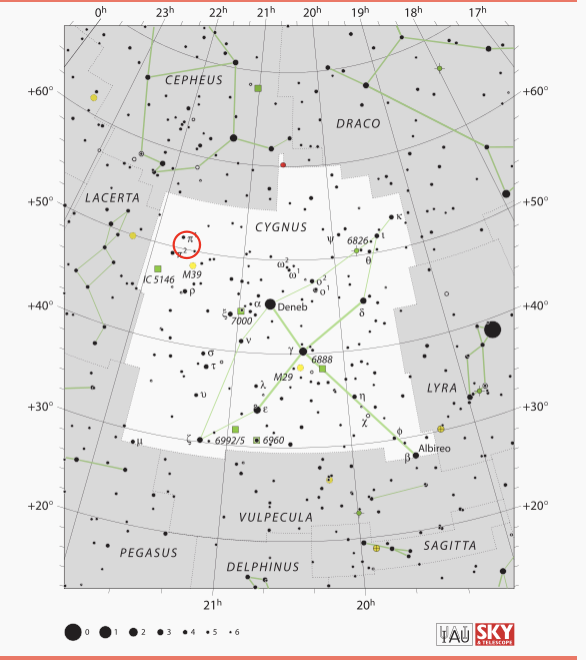
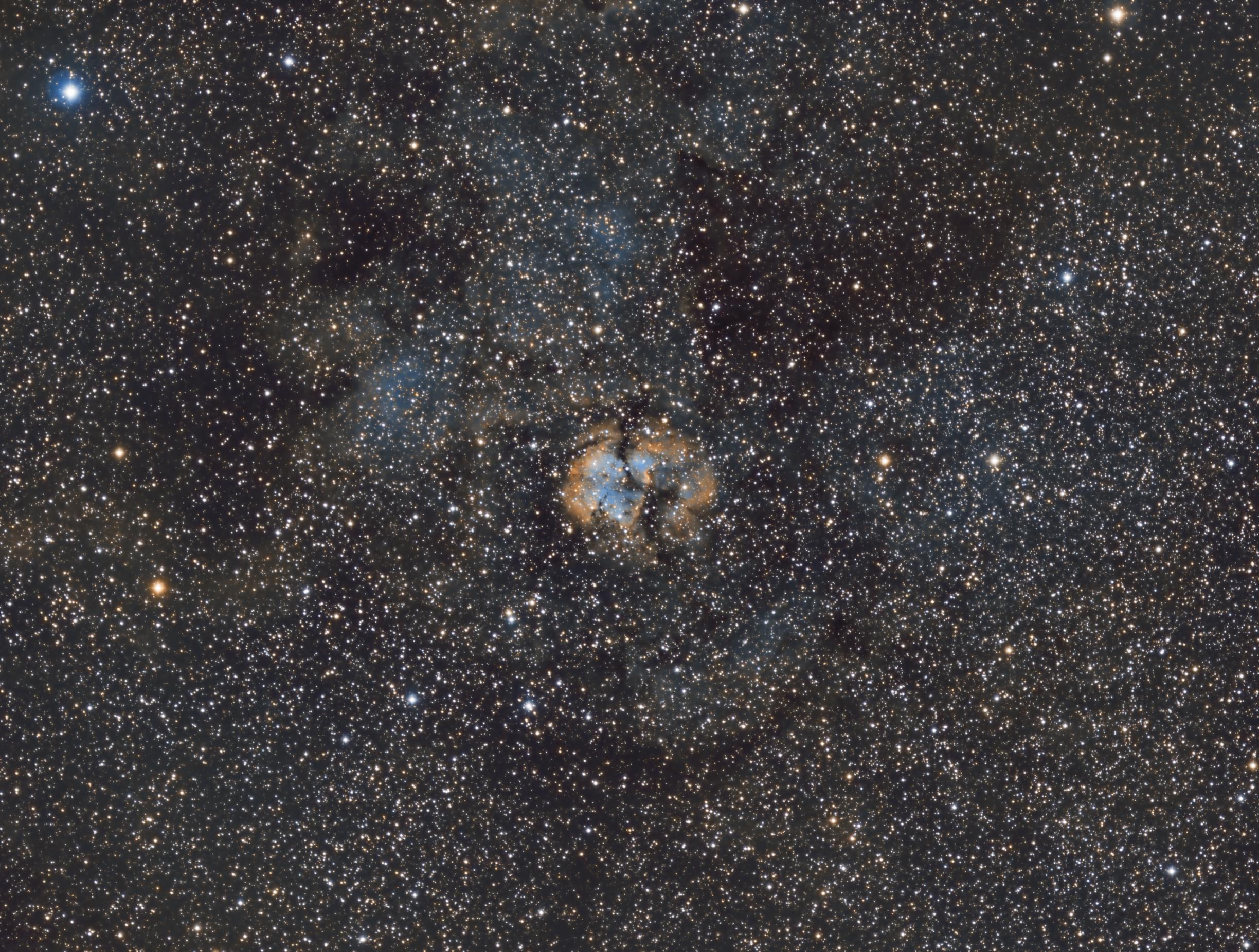
| Comment | Sh2-124 is a large visible emission nebula in the constellation of the Swan. It is identified on the north-western edge of the constellation, along the Milky Way, east of the pair of stars ρ1 Cygni and ρ2 Cygni; the most suitable period for its observation in the evening sky falls between the months of July and December and is considerably facilitated for observers placed in the regions of the boreal hemisphere. Sh2-124 is an extensive and enigmatic nebulous system, linked to the infrared source RAFGL 2789, which is identified with the stellar counterpart known as V645 Cygni, probably a class O star or an Ae / Be star of Herbig. The complex is probably located within the Braccio di Orione at a distance of about 2600 parsecs (about 8480 light years), although this is the most widely accepted distance estimate, distances of up to 4500 parsecs have been proposed. If the estimate of 2600 parsec is correct, this nebula could be in an inter-arm region or close to the internal edge of the Perseo Arm, in the foreground of the Cepheus OB1 association. The main stars responsible for the nebula gas ionization would be a blue star of spectral class O7V and a blue star of class B2V, to which perhaps others would be added. The nebula hosts star formation processes and is in fact included in the Avedisova Catalog as object number 1220; within it some infrared sources have been identified, five of which are identified by the IRAS satellite. Two masers were also detected, one with H2O emissions centered on the V645 Cygni component and one with CH3OH emissions.
|
|||