Click on the image for FULL RES |
||||
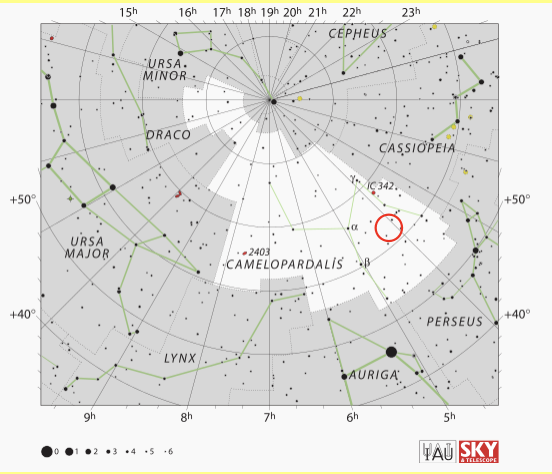
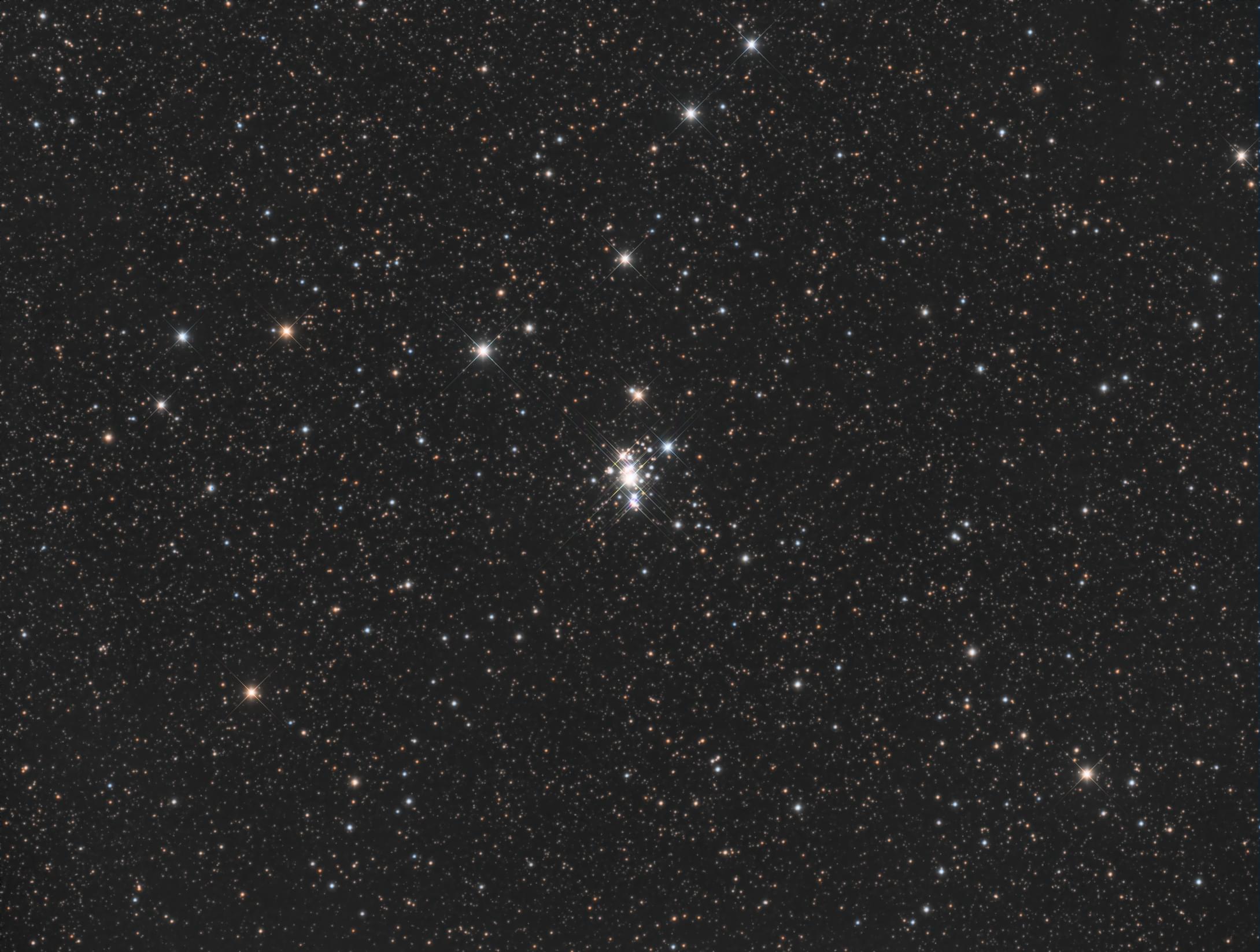
| Name / Constellation | NGC 1502 |
Other: Cr 45; OCISM 94; OCl 383; C 0403+622 |
Cam |
|
| Coordinates | AR: 04h 07m 50s - Dec: +62° 19′ 54″ | |||
| Optics | Takahashi FSQ 106N APO Fluorite F5 - 60/220 guiding refractor | |||
| Camera-Mount | SBIG STF8300M - Orion StarShot Guider - 10Micron GM2000 QCI Mount | |||
| Filters | Baader LRGB | |||
| Exposure |
|
|
|
|
| Location / Date | Promiod (Valle D'Aosta-Italy) "TLP" Remote Observatory - o4 dec 2018 | |||
| Seeing | About 3.5 - 4" @ 2.1 arcosec/pixel unbinned | |||
| Note | Bad seeing | |||
| Acquisition | MaxIm DL - CCD Autopilot 5 | |||
| Processing | Adobe Photoshop CS6 -  |
|||
| Comment | NGC 1502 is a small open cluster of approximately 45 stars in the constellation Camelopardalis. Kemble's Cascade seems to "flow" into NGC 1502. It is identified in the southern part of the constellation in a region poor with flashy stars and strongly obscured by interstellar powders; it forms the southeastern end of the Kemble Cascade, a long visible alignment of stars with binoculars. Through this instrument the cluster appears as a small and dense thickening of blue stars of magnitude 7 and 8, surrounded by an apparent nebulosity; a 100mm telescope is already enough to solve it in some close stars up to magnitude 12, leaving no trace of residual nebulosity. With even larger tools the resolution is optimal and the components, often arranged in pairs, are well separated from each other.The strongly northern declination of this cluster greatly favors the observers of the northern hemisphere and is circumpolar until the latitudes close to the tropics; from the southern hemisphere his observation is therefore penalized and it is impossible to move away from the tropical strip. The best period for his observation in the evening sky is the one between October and March. NGC 1502 was first identified by William Herschel on November 3, 1787 through an 18.7-inch reflector telescope; he described it as a cluster of rather rich and remarkably dense stars with a somewhat elongated shape. His son John Herschel later re-examined it and then inserted it into his General Catalog of Nebulae and Clusters with the number 802. Camaleopardis, an eclipse variable located at the center of the cluster. It is also believed that the blue supergiant α Camelopardalis was originally a member of the cluster, but then it would have been expelled from it, becoming a fugitive star. The cluster is located at a distance of 821 parsec (3400 light years) and falls on the outer edge of the Orion's Arm. The six brightest components of the cluster are of B3 or warmer spectral class; among these, the two brightest stars are binary spectroscopic and together with some weaker partners they form the star system ADS 2984. It is believed that NGC 1502 belongs to Camelopardalis OB1, an OB association whose age must be estimated with greater accuracy, but which seems to be around 11 million years at most; in particular, this cluster belongs to the Cam OB1-C subgroup. The total size of the association, taking into account an average distance equal to 1000 parsec, is equal to about 70-90 parsecs, a diameter quite typical for an association OB. [8] A number of nebulae are linked to Cam OB1, including the H II Sh2-205 region and the reflection nebulae vdB 14 and vdB 15.
|
|||