Click on the image for FULL RES |
||||
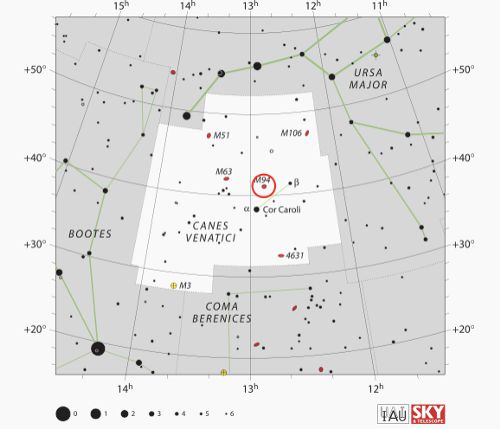
| Name / Constellation | M 94 |
Other: NGC 4736, UGC 7996, PGC 43495 | CVe |
|
| Coordinates | AR: 12h 50m 53,1s - Dec: +41° 07′ 14″ | |||
| Optics | Richtey-Chretien Officina Stellare 10"@F8 Carbon Truss | |||
| Camera-Mount | SBIG ST10XME/CFW10/ONAG/ST8300 guider - 10Micron GM2000 QCI Mount | |||
| Filters | Astrodon LRGB TruBalance (Gen 2) | |||
| Exposure |
|
|
|
|
| Location / Date | Promiod (Valle D'Aosta-Italy) "TLP" Remote Observatory - 22 march (RGB) & 16 apr (Lum) 2018 | |||
| Seeing | About 3.5 " (Lum) & over 4" (RGB) - 0.71 arcosec/pixel image scale unbinned | |||
| Note | Very bad seeing | |||
| Acquisition | MaxIm DL - CCD Autopilot 5 | |||
| Processing | Adobe Photoshop CS6 -  |
|||
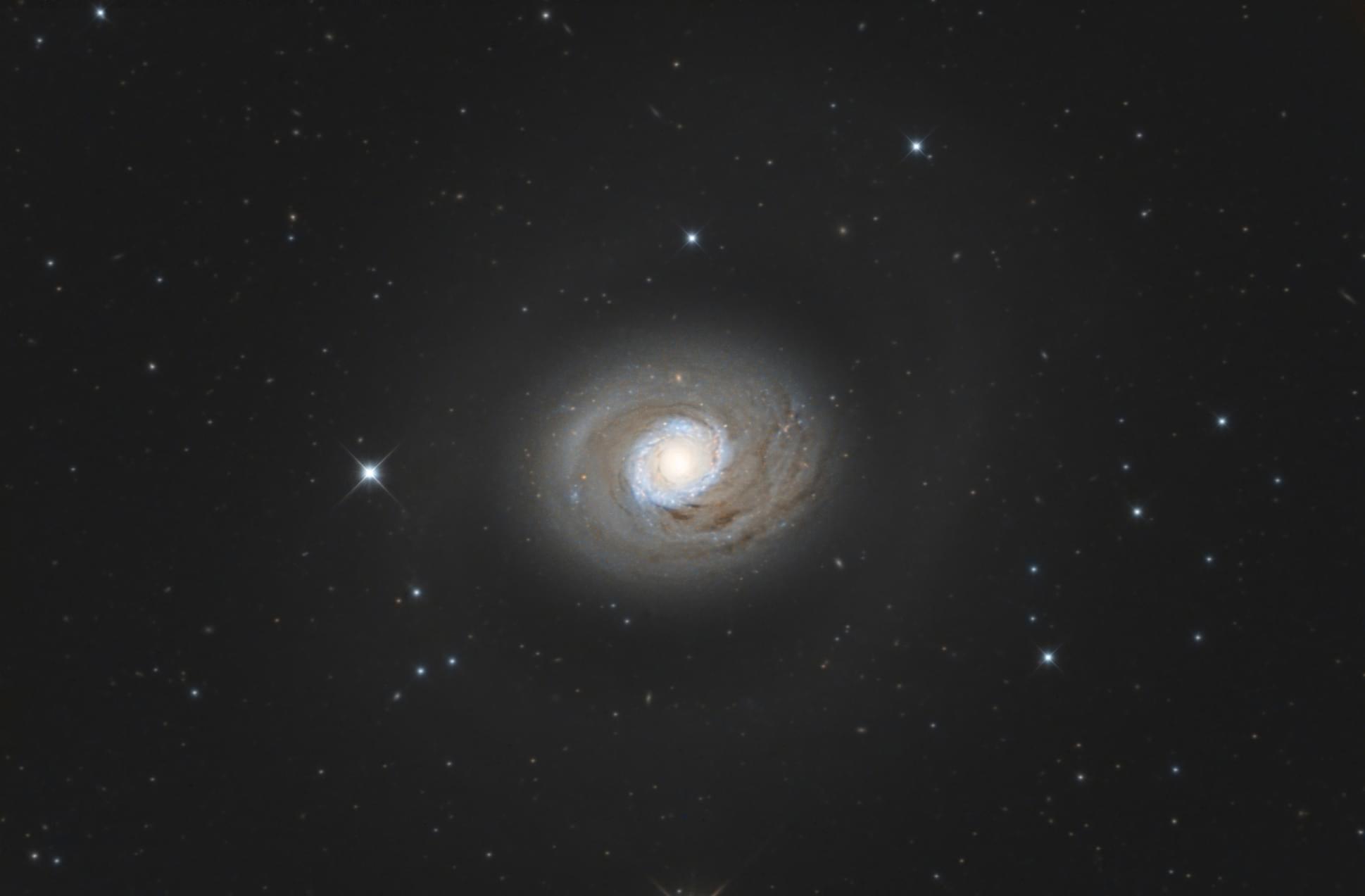
| Comment | Messier 94 (also known as NGC 4736) is a spiral galaxy in the constellation Canes Venatici. It was discovered by Pierre Méchain in 1781, and catalogued by Charles Messier two days later. Although some references describe M94 as a barred spiral galaxy, the "bar" structure appears to be more oval-shaped. The galaxy has two ring structures. M94 is classified as having a low ionization nuclear emission region (LINER) nucleus. LINERs in general are characterized by optical spectra that reveal that ionized gas is present but the gas is only weakly ionized (i.e. the atoms are missing relatively few electrons). M94 contains both an inner ring with a diameter of 70 arcseconds and an outer ring with a diameter of 600 arcseconds. These rings appear to form at resonance locations within the disk of the galaxy. The inner ring is the site of strong star formationactivity and is sometimes referred to as a starburstring. This star formation is fueled by gas that is dynamically driven into the ring by the inner oval-shaped bar-like structure.
|
|||