Click on the image for FULL RES |
||||
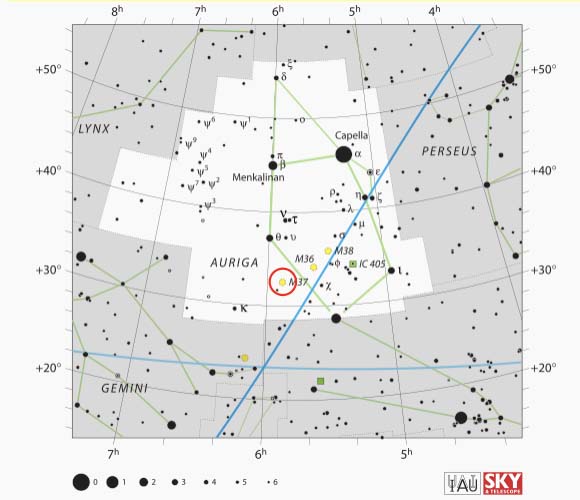
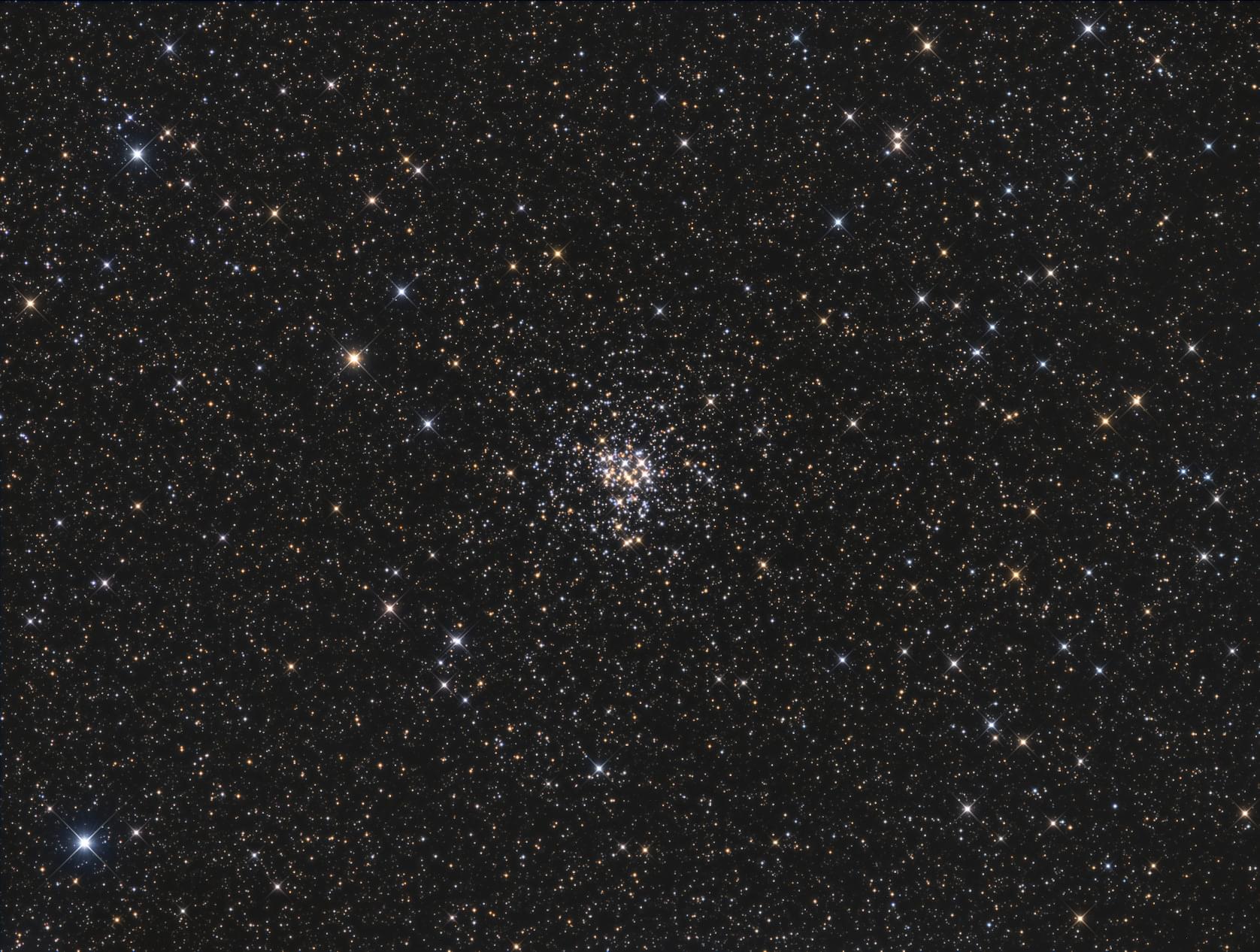
| Name / Constellation | M 37 |
Other:NGC 2099, Cr 75, Mel 38, Lund 115, h 369, GC 1295 | Aur |
|
| Coordinates | AR: 05h 52m 18.3s - Dec: +32° 33′ 11″ | |||
| Optics | Takahashi FSQ 106N APO Fluorite F5 - 60/220 guiding refractor | |||
| Camera-Mount | SBIG STF8300M - Orion StarShot Guider - 10Micron GM2000 QCI Mount | |||
| Filters | Baader RGB | |||
| Exposure |
|
|
|
|
| Location / Date | Promiod (Valle D'Aosta-Italy) "TLP" Remote Observatory - 20 feb 2018 | |||
| Seeing | About 3.8 " @ 2.1 arcosec/pixel unbinned | |||
| Note | ||||
| Acquisition | MaxIm DL - CCD Autopilot 5 | |||
| Processing | Adobe Photoshop CS5 -  |
|||
| Comment | Messier 37 (also known as M37 or NGC 2099) is the richest open cluster in the constellation Auriga. It is the brightest of three open clusters in Auriga and was discovered by the Italian astronomer Giovanni Battista Hodierna before 1654. M37 was missed by French astronomer Guillaume Le Gentil when he rediscovered M36 and M38 in 1749. French astronomer Charles Messier independently rediscovered M37 in September 1764. M37 is located in the antipodal direction, opposite from the Galactic Center as seen from Earth.[4] Estimates of its age range from 347[1] million to 550[3] million years. It has 1,500[2] times the mass of the Sun and contains over 500 identified stars,[3] with roughly 150 stars brighter than magnitude 12.5. At its estimated distance of around 4,500 light-years (1,400 parsecs)[1] from Earth, the cluster's angular diameter of 24 arcminutes corresponds to a physical extent of about 20–25 ly (6.1–7.7 pc).
|
|||